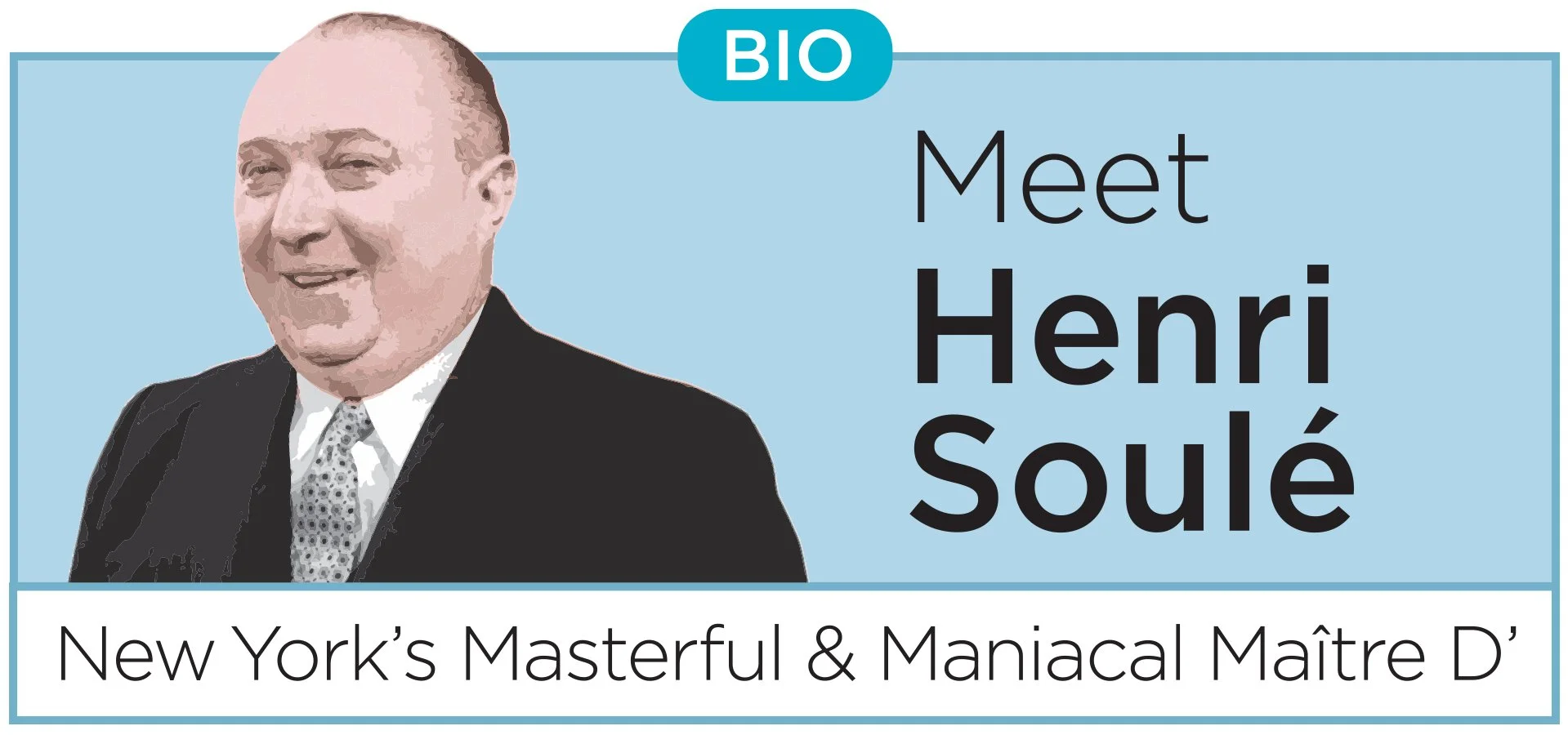
“The Michelangelo, the Mozart and the Leonardo of the French restaurant in America.” - Craig Claiborne, New York Times
“Showman, snob, perfectionist, martinet, con-man, wooer and wooed master of haute cuisine.” - Gael Greene, New York Magazine
When the French government was planning the restaurant for their France Pavilion in the 1939-40 New York World’s Fair, they entrusted the project to Jean Drouant, owner of three celebrated Parisian restaurants. He brought to New York his best kitchen and dining room talent, including Maître d’ Henri Soulé to manage the first true French eatery in America.
France Pavilion, 1939-40 New York World’s Fair (postcard from author’s collection).
“Le Restaurant du Pavillon de France,” referred to simply as “The French Restaurant,” introduced countless dishes to America, such as crêpes suzette, fois gras, duck confit, and Billi Bi (mussel soup). Located in a dramatic setting overlooking the Lagoon of Nations and its nightly fireworks show, Le Restaurant became wildly popular, serving more than 136,000 meals in its first 6-month run. Despite being the Fair’s most expensive eating place, New Yorkers clamored for reservations, even though they had to take public transportation to get there.
Dining al fresco at Le Restaurant (New York Public Library).
When the Fair closed in 1940, World War II was raging in Europe, so Soulé and much of his staff decided to remain in America. He bought and moved Le Restaurant to 5 East 55th Street in Manhattan and renamed it “Le Pavillon.” It was an immediate success, dominating the New York and national restaurant scene for more than 20 years, redefining haute cuisine in America as being undisputedly French.
Soulé outside his Manhattan restaurant (Life Magazine).
It was at Le Pavillon that the legend of owner and maître d’ Soulé became infamous. The Basque native stood a mere 5’-5”, and was described by critic Gael Greene as “pasty-faced with owl eyes.” Soulé mastered the arbitrary forms of social distinction, earning the restaurant (and future French eateries) the reputation of being “snobby.”
“The Master” seats you (New York Times).
When guests arrived, they were greeted by Soulé. He would immediately size them up and seat them in a location according to their appearance, wealth, fame, or deference to the “Master.” Those who didn’t make the grade would be seated in “Siberia,” a distant corner of the dining room. Taking cues from Broadway and Hollywood, Soulé knew that there had to be “bad” tables in order for those at prime tables to feel privileged and favored. Soulé took full advantage of clients’ jockeying for a prime position, ruling his kingdom with total authority. One reviewer advised potential Le Pavillon diners: “You should be famous, if you can manage it, if not, you should at least be rich, elegant, chic and witty. Be careful of your manners and careless with your money.”
Soulé helps create the mood (Al Finn/Getty).
A genius at tableside preparation (Forbes).
Soulé disliked smoking at the table, women drinking, and the American habit of eating quickly. He mistreated and underpaid his chefs and staff, sometimes causing their exodus, and had to close the restaurant until he could re-fill the positions. Despite training an entire generation of French chefs, many departed from Soulé’s tyranny, such as Pierre Franey and Jacques Pepin, who left to work for Howard Johnson’s.
Due to a quarrel with his landlord, Soulé moved Le Pavillon to 57th Street. The original 55th Street location remained abandoned, so in 1958 he took it over and opened La Côte Basque, which instantly became as popular as Le Pavillon. Now Soulé could imbue both locations with the finest cuisine, and his discrimination and intimidation.
La Côte Basque (Life and People Magazine).
One famous fight took place at La Côte Basque in 1960, when the dining Kennedy family was interrupted by an intrusive photographer, and they told him to leave. The incensed Soulé took the photographer’s side, reminding the famous family that he, and only he, decided who could populate his restaurant. The Kennedys walked out and took their business to the new La Caravelle (and hired its chef for the White House.)
Soulé enjoys his favorite dish: cod, prepared simply (Food & Wine).
Soulé died mysteriously of heart failure in the men’s room at La Côte Basque, leaving both restaurants to his wife, Olga. This was a surprise to the staff, who for years assumed that he was married to Henriette Spalter, the hat-check girl, who turned out to be his mistress. Despite Olga banning women wearing pants, La Côte Basque still received four stars from Craig Claiborne. In 1975, Truman Capote featured the restaurant in Answered Prayers, destroying the reputation of fifty famous women who dined there. Le Pavillon closed in 1971, and Le Côte Basque bit the dust in 2004.
Capote between two of his “swans” from Answered Prayers. Left: Jean Murray Vanderbilt, Right: Barbara “Babe” Paley (Forbes).
By the 1970s, the dominance of stuffy, pretentious haute cuisine became unraveled by the introduction of “La Nouvelle Cuisine.” Lighter sauces and smaller portions on large plates became hugely popular, for a while. Criticized for high prices and tiny servings, the short-lived fad fell from favor by 1990.
Nouvelle Cuisine. Why am I still hungry?
But Henri Soulé is still remembered today for his contribution to American-French food, despite his tyrannical nature. He produced the country’s finest French cuisine for 22 years, and inspired many young chefs who would achieve their own celebrity status. Pierre Franey recalls Le Pavillon as “a culinary university training French cooks and dining room staffs for service throughout America.”
You can still have a taste of Soulé’s cuisine by visiting a new Le Pavillon, an homage to the original by acclaimed New York chef Daniel Boulud.
Chef Daniel Boulud at his new Le Pavillon.